

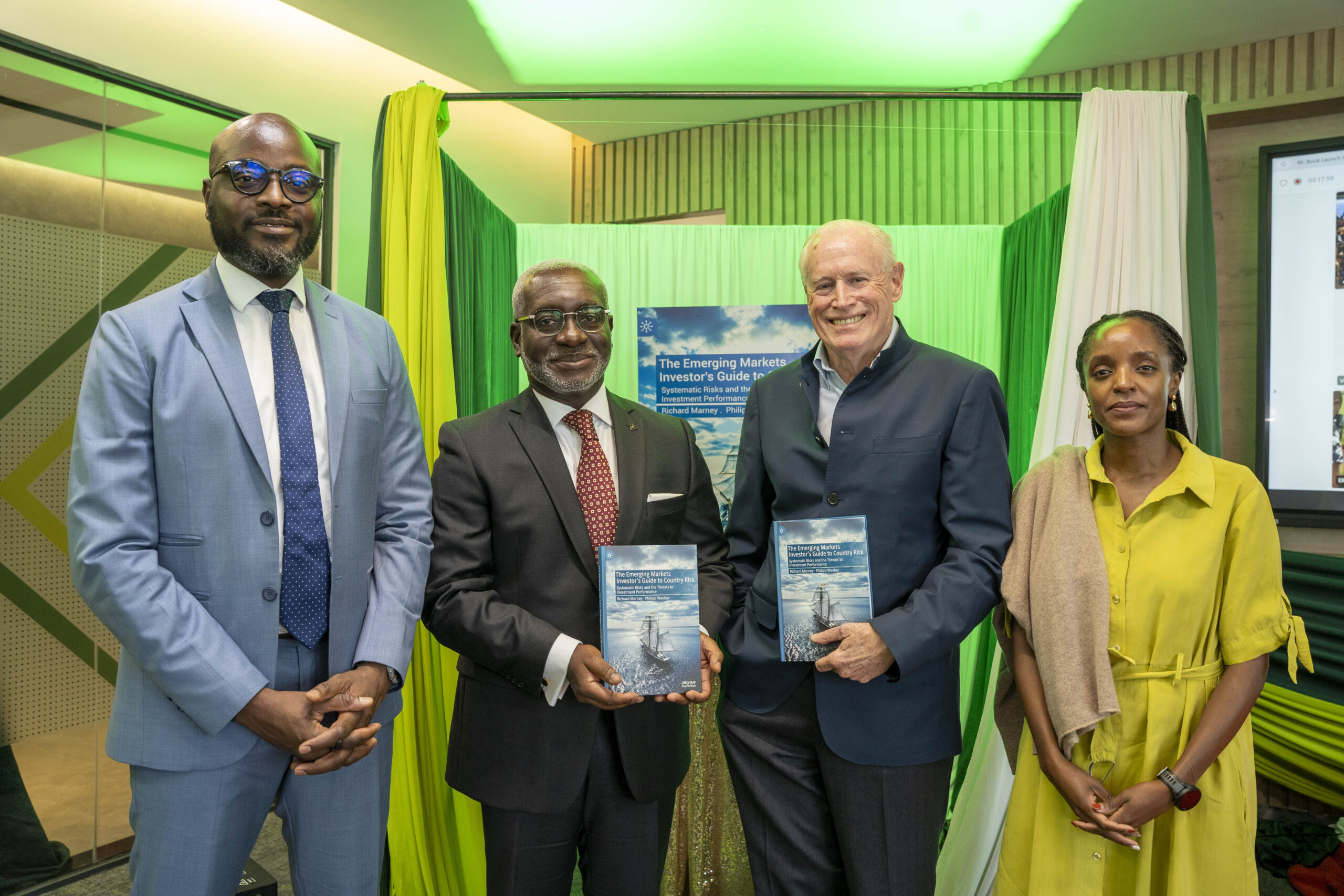
AGF staff, led by the Group Chairman, Felix Bikpo and the Group CEO, Constant N’zi, had the pleasure of attending the launch of the book titled The Emerging Markets Investor’s Guide to Country Risk by Richard Marney, an AGF Board Member and Philipp Waeber.
The authors introduced the Investor’s Rutter framework, which evaluates country risk through four interrelated dimensions: endowments, enablers, context and outcomes. Endowments refer to the resources and assets a country possesses such as natural resources, human capital, geography and demographics. Enablers comprise institutions, governance structures, policies, infrastructure and financial systems that determine how effectively resources can be utilized. Context encompasses domestic and external forces shaping a country’s environment, including economic conditions, geopolitical developments, market dynamics or global trends. Together, these dimensions influence outcome, which is the resulting economic, financial and investment performance observed over time. The framework emphasizes that assessing country risk requires understanding not only a country’s current state but also how these dimensions interact and evolve over time.
The discussion further highlighted that while both country and investment risk are distinct, they are interconnected and should not be considered in isolation when evaluating investment opportunities. One insightful aspect of the framework was the analogy of a country’s investment en
vironment to “weather”, “wind” and “currents”. The weather represents short-term developments and conditions, such as inflation, political announcements and economic shocks. The winds reflect the direction of policy and reform, including monetary policy, fiscal reforms and government measures to spur economic growth. The currents, particularly a country’s endowments and enablers determine how these factors ultimately translate into economic and investment outcomes. It is without any doubt that the strength of a country’s enablers, together with how effectively its endowments are utilized, play a critical role in determining economic outcomes. A country may possess significant natural resources, human capital, financial resources or geographic advantages but these endowments do not automatically translate into higher economic output. Their contribution depends on the strength of the institutions, policies, infrastructure, financial systems and private-sector capabilities that effectively mobilize and utilize them. This enabler perspective is particularly relevant to the space in which AGF operates, where guarantees and risk-sharing mechanisms can contribute to strengthening enablers that support private-sector development and those that provide access to finance such as banks and micro-finance institutions.
The book reinforces the importance of looking beyond prevailing economic conditions and considering the underlying institutional, financial and structural factors that determine how effectively an economy can utilize its endowment capabilities and respond to changing circumstances. Ultimately, understanding these dynamics provides a more comprehensive basis for assessing how country-level risks can translate into either constraints or opportunities for investment, private-sector development, economic growth and increased economic output.
